Artificial intelligence has quickly moved from experimentation to the boardroom. Yet for many organisations, the biggest obstacle to using it effectively is not the AI model itself.
It is everything underneath it.
ERP systems, CRMs, finance applications, operational platforms, spreadsheets, documents and external data sources often contain different pieces of the same business. Each may work perfectly well independently, while the organisation still lacks a consistent view of its customers, products, projects, transactions and operations.
That is where HippoScripts Technologies is increasingly focused: Removing the barriers created by disconnected systems and fragmented data, and building the technology foundations businesses need to operate better and grow further.
Founded by Andrew Sammut following more than a decade working in data engineering, analytics and technology leadership, including as CTO and Lead Data Scientist within commodities investment management, HippoScripts designs and implements trusted data platforms and enterprise AI systems.
WhosWho.mt speaks with Andrew Sammut about why enterprise AI needs more than data, what business ontologies actually mean, and why the next generation of intelligent organisations will need their technology to understand how the business itself fits together.
What problem did you set out to solve when you founded HippoScripts?
After more than a decade working with data, what became very clear to me is that businesses do not always need more systems. Quite often, what they actually need is for the systems they already have to work seamlessly together.
You can have a strong ERP, CRM, finance system and operational applications, but if information moves between them manually, definitions are inconsistent and management still relies on spreadsheets to see the whole picture, the business remains fragmented.
I founded HippoScripts around the idea that there has to be a strong engineering foundation first. We integrate systems, build trusted data platforms and create the structures that allow analytics, automation and AI to work on information that the organisation can actually rely on.
My background in investment management also shaped how we approach engineering. In environments where data supports investment, risk and management decisions, reliability, traceability and resilience are not optional. That discipline remains central to the way we build today.
What does a trusted data platform actually look like?
It starts with integration.
Data needs to move reliably from the systems where the business operates into an architecture where it can be validated, modelled, governed and reused.
That involves data pipelines, cloud platforms, warehousing, quality controls, observability, lineage, semantic models and access governance. The important point is that these are not independent technical exercises. They have to work as one system.
We work across modern enterprise environments including Microsoft Azure, Microsoft Fabric, Synapse, Databricks, Snowflake and AWS. We do not believe in replacing technology simply for the sake of introducing something new. If a client's existing platform works, we integrate with it and build around it.
Data and AI observability is particularly important. Building a pipeline is one thing; knowing when data has stopped arriving, changed unexpectedly or failed a quality rule is another. The same applies to AI systems, where changes in model behaviour, outputs or usage need to be visible and monitored. Enterprise platforms should be engineered so that problems are detected early, rather than discovered later in a board report or business process.
At scale, that matters. One production platform we currently engineer processes around 1.4 billion rows during its nightly workloads. Reliability has to be designed into the architecture from the beginning.
HippoScripts is increasingly talking about business ontologies. What does that mean in practice?
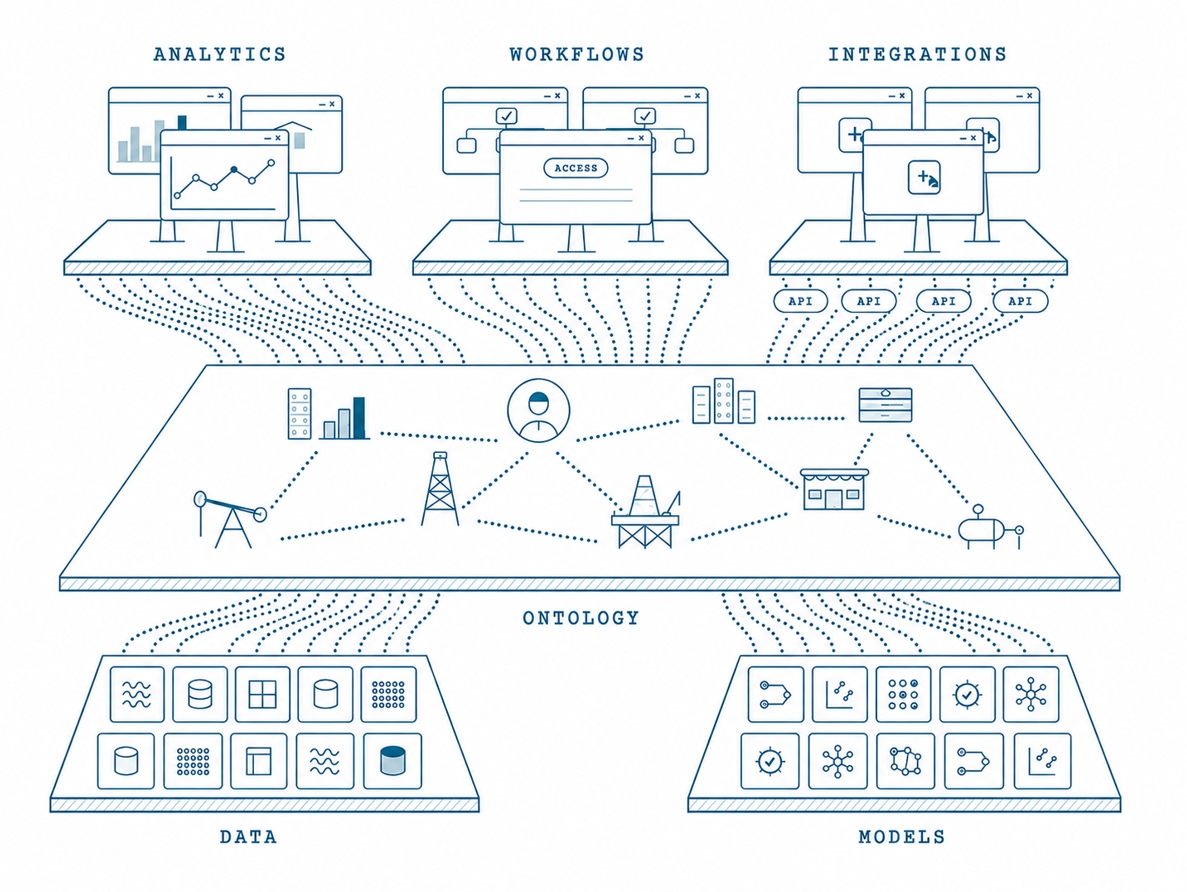
HippoScripts' business ontology provides a shared layer connecting enterprise data and models with analytics, workflows and integrations.
Ontology can sound abstract, but the underlying problem is very practical.
A data warehouse can tell you that Customer 123 generated a particular transaction. A business needs to understand much more: who that customer is, which projects or orders they relate to, which products are involved, what rules apply, which workflows are active and what actions can legitimately happen next.
A business ontology creates that shared representation
It connects the real entities within the organisation including customers, products, projects, assets, orders alongside the data, relationships, analytical models, business rules, workflows and actions surrounding them.
That means people, applications and eventually AI agents can work from the same understanding of the business.
For me, that is an important evolution beyond traditional analytics.
A warehouse helps answer what happened. A semantic model helps make sure the organisation measures it consistently. An ontology adds the operational context required to understand how those things relate and what can happen next.
Why is that becoming important now that companies are adopting AI?
Because AI needs more than access to information. It needs context.
An AI model can be extremely capable, but if it is working across fragmented sources, conflicting definitions and disconnected workflows, you are simply putting intelligence on top of ambiguity.
That is why I believe the conversation around enterprise AI is moving from models towards architecture.
Once the data is governed and the business context is understood, AI becomes much more useful. Generative AI can support document analysis and internal search, machine learning can improve forecasting and predictive models, while agentic AI can support workflows and controlled actions across systems.
Good architecture can also make AI more efficient. Models typically consume and are priced according to the volume of information they process, measured in tokens. Giving an AI agent the right context at the right time can reduce the need to repeatedly process large amounts of irrelevant information, potentially improving response times and the economics of AI at scale.
I often compare tokens to fuel. A powerful engine can consume a lot of fuel if the system around it is inefficient. The same applies to AI. Better architecture and business context can help the model reach the right outcome without unnecessarily processing everything around it.
But the goal is not to put AI everywhere. The goal is to identify where intelligence genuinely improves how an organisation operates, while ensuring that its answers and actions can be traced back to trusted information and approved business logic.
A clever model built on fragmented data is still a fragile system.
Are companies at risk of investing too heavily in sophisticated data architecture before identifying AI use cases that can deliver a tangible return?
Absolutely, if the architecture becomes the objective.
We do not believe every organisation needs the same technology stack, or that every AI use case requires a major data-platform programme. The starting point should be a real business problem and a measurable outcome.
For one organisation, the right answer might be a focused integration and a well-governed dataset. For another, its complexity, scale or regulatory requirements may justify a broader data platform and ontology.
The investment has to be proportionate to the value it can create, whether that comes through reducing manual work, lowering operating costs, improving decision-making, reducing risk or enabling new revenue opportunities.
The goal is to build the smallest reliable foundation that solves the problem properly and can evolve with the business, rather than over-engineering upfront or taking shortcuts that force you to rebuild later.
A scalable architecture should reduce complexity and operating cost while creating a foundation that can evolve with the business.
How important are governance, security and resilience in that architecture?
They are part of the architecture rather than something we add afterwards.
HippoScripts is ISO/IEC 27001:2022 certified, and that has reinforced an approach we already believed in: access controls, information security, governance, auditability and operational resilience should be designed into technology from the beginning.
This becomes particularly important in regulated sectors. Within financial services, for example, the Digital Operational Resilience Act (DORA) has made ICT risk management, resilience testing, incident management and third-party technology risk much more explicit at European level.
Our role is at the engineering layer.
When we build data platforms for regulated organisations, we think about questions such as: Where did this number originate? Which transformation changed it? Who has access? What happens if a pipeline fails? Can we reconstruct the lineage? Can the process recover? Can somebody evidence how the system behaved six months later?
Those may sound like governance questions, but many of the answers ultimately depend on architecture and engineering. That is why strong data engineering and operational resilience are becoming increasingly intertwined.
Where does AperturesConnect fit into the wider HippoScripts story?
AperturesConnect is one example of the same thinking translated into an operational platform.
Developed for the window, door and glass industry, it connects commercial, quotation, measurement, order and operational workflows on a common foundation that can support day-to-day execution, analytics and AI.
For us, the important point is broader than one industry. It demonstrates how domain understanding, data engineering and operational technology can be combined into sector-specific technology. AperturesConnect has also been showcased internationally at Fensterbau Frontale in Germany, one of the sector's major trade events.
You have a particularly strong background in financial services, while HippoScripts is also becoming visible in manufacturing. Are those two areas becoming strategic priorities?
We see strong potential in both, but for different reasons.
Funds, investment firms, banks, insurers and administrators operate in environments where data quality, traceability, security and resilience directly affect critical processes. That makes the foundations-first approach especially relevant.
Manufacturing has a different operational rhythm, but an equally interesting data challenge. Manufacturers generate enormous amounts of information across sales, purchasing, inventory, production and finance, yet much of it remains fragmented across disconnected applications.
The opportunity is to connect those operational signals so companies can improve forecasting, production planning, visibility and ultimately decision-making.
We also see the same underlying architectural challenges in other data-intensive environments. Our published work includes projects spanning maritime intelligence, regulated fund-administration data and enterprise analytics.
From our base in Malta, our international footprint now extends to Italy, Luxembourg and the United Kingdom, with further expansion underway.
On 16 September, I will be speaking at The Malta Chamber's “The Intelligent Factory – Turning Manufacturing Data into Better Decisions” workshop, which is focused precisely on this opportunity.
What does the next stage of growth look like for HippoScripts?
Depth first, then scale.
We want HippoScripts to be recognised for understanding the complexity of modern data environments and engineering technology that works in practice, rather than chasing technology for technology's sake.
That means continuing to deepen our capabilities around data platforms, observability, ontology, enterprise AI and governance, while growing internationally.
Malta is where we started, but from the outset our ambition has been to build an international business.
If there is one idea you want business leaders to take away about AI, what would it be?
Do not start by asking where you can add AI.
Start with the business problem, then build the level of data, context and governance that the use case genuinely requires.
Trusted data is the foundation. Intelligent action is the outcome.
Learn more about HippoScripts Technologies at hipposcripts.com, or get in touch at [email protected] to explore how we could support your next stage of growth.
Main Image: