STRADA – short for Self-supervised Transformers for Radio Astronomy Discovery Algorithms – is a research project led by the University of Malta in collaboration with the Italian National Institute for Astrophysics (INAF). The initiative is developing artificial intelligence designed specifically to interpret images captured by radio telescopes.
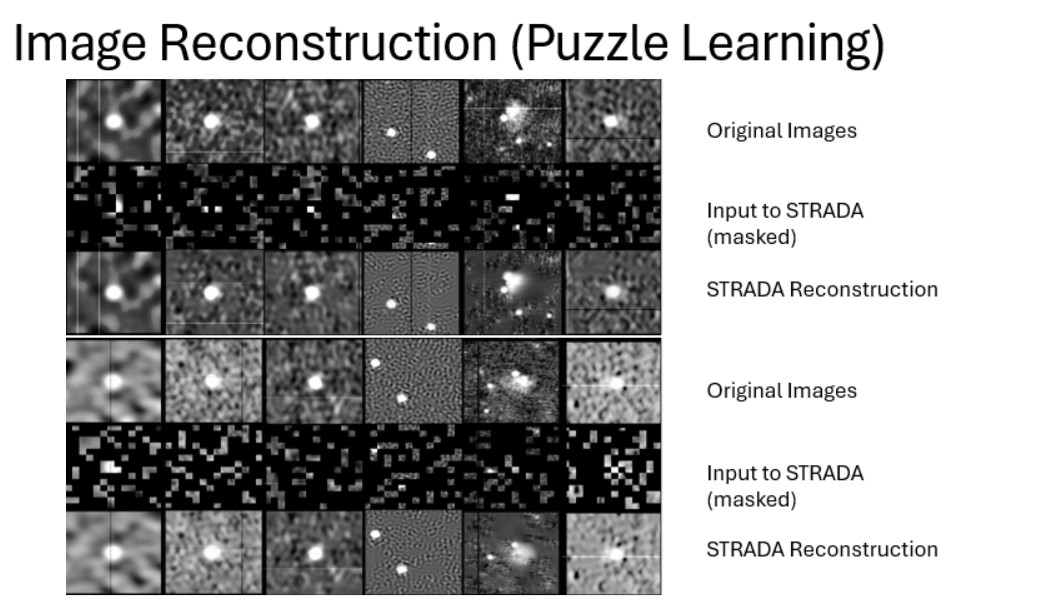
At the centre of the project is STRADAViT, an AI model built using Vision Transformer technology. Unlike conventional AI systems that rely heavily on thousands of manually labelled examples, STRADAViT uses a technique known as self-supervised learning. This allows it to learn directly from vast collections of unlabelled radio astronomy images by recognising patterns and structures on its own.
Andrea DeMarco, Senior Lecturer at the Institute of Space Sciences and Astronomy at the University of Malta tells WhosWho.mt that this approach is particularly valuable because producing expert-labelled astronomical data is both time-consuming and resource-intensive.
Once trained, the model can be adapted for a range of scientific tasks, including identifying different types of radio galaxies, filtering image artefacts, highlighting unusual celestial objects and helping astronomers decide which observations deserve closer human investigation.
The project addresses one of the biggest challenges facing modern radio astronomy: data.
New generations of radio telescopes are producing far more information than scientists can realistically analyse manually. Rather than replacing astronomers, STRADA is designed to act as a first layer of analysis, sorting through enormous datasets, recognising broad patterns and flagging potentially interesting discoveries.
The need for such tools is expected to become even greater with next-generation facilities such as the Square Kilometre Array, which will dramatically increase the amount of radio astronomy data available to researchers worldwide.
One of STRADA's objectives is to create AI that works effectively across different radio surveys. Images captured by different telescopes can vary significantly because of differences in resolution, noise levels and observation methods, making it difficult for traditional AI systems trained on one dataset to perform well on another.
Dr DeMarco explained that the idea for STRADA emerged from his work within the University of Malta's Institute of Space Sciences and Astronomy and its involvement in the wider Square Kilometre Array ecosystem.
"It became clear very early on that the future challenge would not simply be building more powerful telescopes, but developing intelligent ways to process and interpret what those telescopes produce," he said.
The project also builds on earlier research into radio-source detection and classification, shifting the focus from creating AI for a single specialised task to developing a reusable foundation model that can support a wide range of radio astronomy applications.
Initial feedback from the scientific community has been encouraging.
Dr DeMarco noted that while STRADAViT does not outperform every existing AI model in every scenario, the results indicate that training AI specifically on radio astronomy data provides a stronger foundation for many scientific applications than treating radio images like ordinary photographs.
The research has been released publicly and is currently under review by the Journal of Astronomy and Computing. An open version of the STRADAViT model has also been made available, allowing researchers around the world to test, improve and build upon the work.
Beyond its scientific contribution, Dr DeMarco believes the project demonstrates how Malta can play an active role in international, data-intensive research by developing original AI technologies that support some of the world's most ambitious astronomy projects.
Main Image: