SpaceX’s initial public offering (IPO) has caused serious market hype around the world and Malta is no exception.
Curmi & Partners Chief Officer for Client Relations David Curmi told WhosWho that he noticed a “significant demand” in SpaceX from the local market since its IPO last Friday.
The space stock soared past $200 per share in its third day of trading, way past the initial $135 IPO price.
But is it time to buy?
Mr Curmi stopped short from recommending whether investors should buy the stock.
“The hype reflects Elon Musk’s cult-like following, as well as the excitement surrounding his vision to explore the Moon, and eventually Mars, and commercialise space,” he said.
“There’s a lot of hype and fascination surrounding the company but a lot of it is built on what Elon Musk is expected to achieve in the future.”
He said that, rather than a proven revenue track record, SpaceX’s valuation is mainly being driven by hope value.
“You’re investing in a dream, and if that dream comes true, the stock’s current value will be very cheap. However, if it doesn’t come true, you might find out that it isn’t worth so much money.”
“There is risk one way or another, but it’s hard to judge whether it’s worth the market hype or not.”
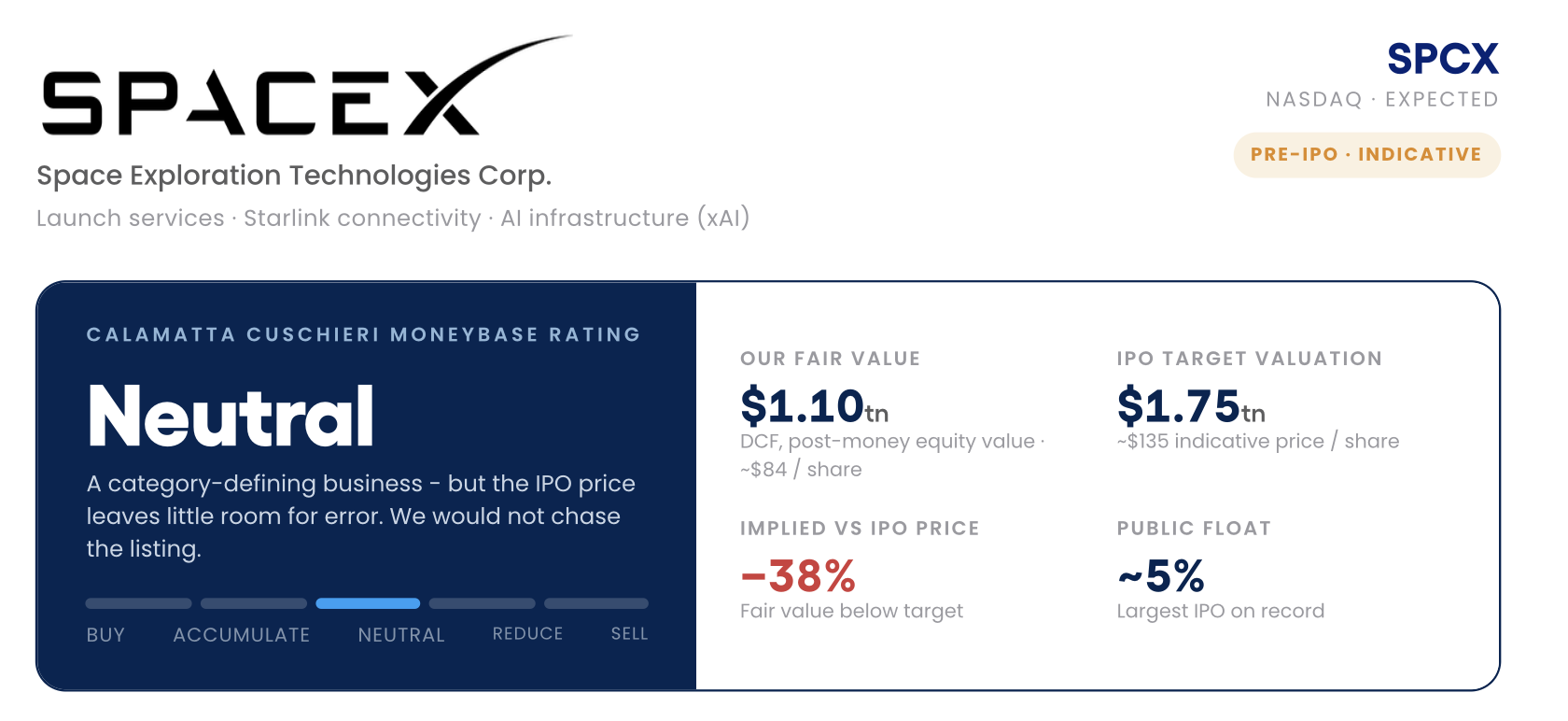
Meanwhile, leading Maltese investment platform Moneybase had recommended people against investing in SpaceX at the initial IPO price.
“SpaceX is one of the most remarkable businesses of its generation. It launches most of the world’s orbital mass, operates the dominant satellite-internet network in Starlink, and is now folding in AI infrastructure. None of that is in question. The question for clients is price,” it said prior to the IPO.
In SpaceX’s favour, Moneybase pointed to Starlink connectivity generating $4.4 billion in operating income in 2025, the company’s dominant and vertically integrated rocket-launch business, and the fact that its in-house capabilities give Starlink a structural cost edge that no competitor can match.
From Moneybase's SpaceX research
However, it also flagged how the group posted a $4.95 billion net loss in 2025 and how xAI posted a $3.2bn revenue but a $5.8bn operating loss.
It also identifies Elon Musk’s control of 85 per cent of voting rights as a governance risk.
Moneybase therefore gave SpaceX a fair value estimate of around $84 per share, encouraging investors to wait for a better entry price before getting involved.
As it stands, SpaceX’s value has shot up to more than double this estimate and the question is now whether it can keep up this momentum.
Part of the enthusiasm was fuelled by the company's decision to reserve around 20 per cent of its IPO for retail investors.
In response, some brokerages lowered the minimum account balance required to request shares to as little as $2,000, compared with the typical $100,000 to $500,000 thresholds. This move helped generate intense early interest among regular investors and must have played some role in the initial spike.
Another key question is whether the expiry of lock-up restrictions for early SpaceX investors could trigger a wave of selling pressure.
As Mr Curmi explained, the market should in the coming months watch the actions of private investors who backed SpaceX before it went public, as some may be tempted to partially or wholly cash out their holdings now the stock has soared in value.
“A significant supply of shares could be released to the market, while at the same time new investors are coming in and SpaceX has gone straight into the S&P and NASDAQ indexes, which means index fund investors are also purchasing the stock. The question will be whether the market will absorb this supply.”
Main Image:Cover photo: Nasdaq