The Malta Business Registry this week is hosting an important international conference in Żejtun, bringing together business registry representatives and experts from across Europe.
The EBRA Malta 2026 conference welcomed delegates from several European registries and industry bodies, with discussions focusing on artificial intelligence, anti-money laundering compliance, digital transformation, transparency, investor confidence, and the evolving role of business registries in modern economies.
The event opened with an unusual and memorable moment centred around AI. Attendees were first shown a deepfake video featuring Maltese personality Clare Agius, before the clip was abruptly cut short and the real Claire Agius appeared on stage. The segment served as an early reminder of both the capabilities and risks linked to artificial intelligence, one of the conference’s themes.

Clare Agius' avatar opening the conference
The conference was organised in collaboration with European Business Registry Association, which is regarded as one of the leading international associations in the field of business registries and related domains. EBRA focuses on promoting best practices, collaboration and knowledge-sharing among registries worldwide.
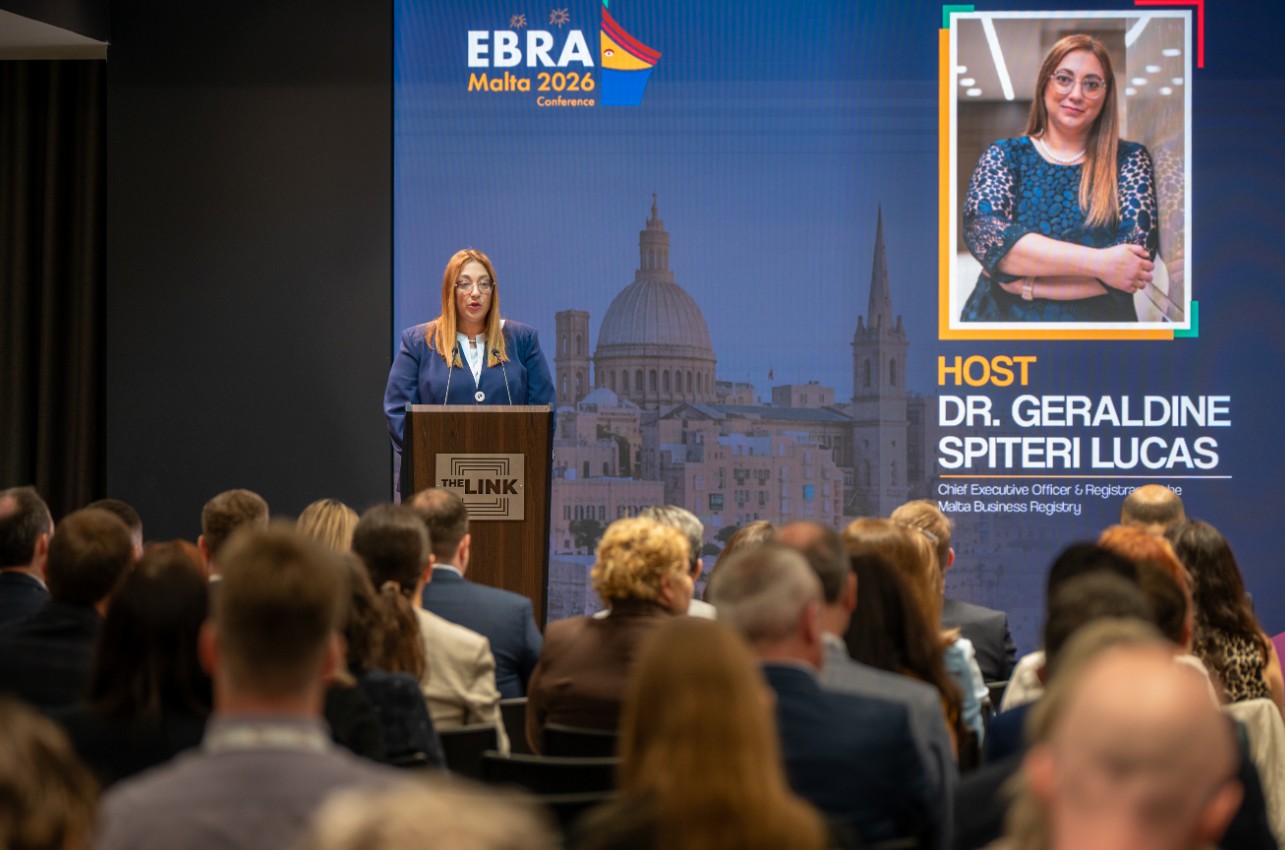
MBR's Chief Executive Officer and Registrar Geraldine Spiteri Lucas
Speaking during the opening session, MBR's Chief Executive Officer and Registrar Geraldine Spiteri Lucas stressed the importance of staying ahead in an increasingly fast-changing environment. She highlighted the need for transparency, collaboration and sustainable solutions, while expressing confidence that the conference would lead to stronger partnerships between registries and institutions across Europe.
Meanwhile, EBRA President Antti Riivari noted that registries are operating in a period marked by rapid digital change and global uncertainty. He pointed to artificial intelligence as one of the sector’s most important emerging themes, while also highlighting increasing obligations linked to anti-money laundering requirements.

EBRA President Antti Riivari
During a detailed presentation on the evolution of company law in Malta, Dr Spiteri Lucas outlined how Malta’s commercial framework has transformed over nearly two centuries.
She explained that between 1857 and 1927, Malta only recognised individuals engaged in commercial activity. The introduction of juridical personality in 1927 later enabled the recognition of joint ventures and legal structures. Further reforms followed in 1954 with Malta’s first commercial partnership law reform, while the Malta Chamber of Commerce served as business registrar from 1956.
Additional milestones included the Commercial Partnership Ordinance in 1962, the Registry of Partnerships under the Commerce Department in 1965, and the introduction of the Companies Act in 1995 – legislation that remains in force today, despite being amended almost annually. In 1997, the Registry of Companies was housed within the Malta Financial Services Authority before the standalone Malta Business Registry was officially established in 2019 following Malta’s alignment with European Union legislation.
Dr Spiteri Lucas also explained how the registry has evolved operationally, with compliance becoming a central and permanent pillar of the organisation. She detailed how the registry has been restructured into more specialised areas handling corporations, dissolutions, beneficial ownership, mobility directives, public companies, publications, scanning of documents, foreign direct investment and cooperatives.
She added that the Malta Business Registry is focusing on attracting quality business, while also modernising its systems through initiatives such as BAROS, an online platform using qualified digital signatures. The system allows users to process appointments and resignations digitally, while facilitating direct correspondence with business owners and legal professionals. According to Dr Spiteri Lucas, the platform currently has around 35,000 users.
She also highlighted Malta’s new Youth Enterprise framework, introduced through The Companies Act (Youth Enterprise) Regulations, 2026, which creates a structured pathway for 16- and 17-year-olds to establish businesses through dedicated private limited liability companies while maintaining safeguards around governance and compliance.
Permanent Secretary for the Economy, Enterprise and Strategic Projects Godwin Mifsud described modern business registries as central to economic growth and investor confidence. He stressed the importance of keeping registries modern, digital and comprehensive, while encouraging attendees to challenge existing systems and remain open to reform.
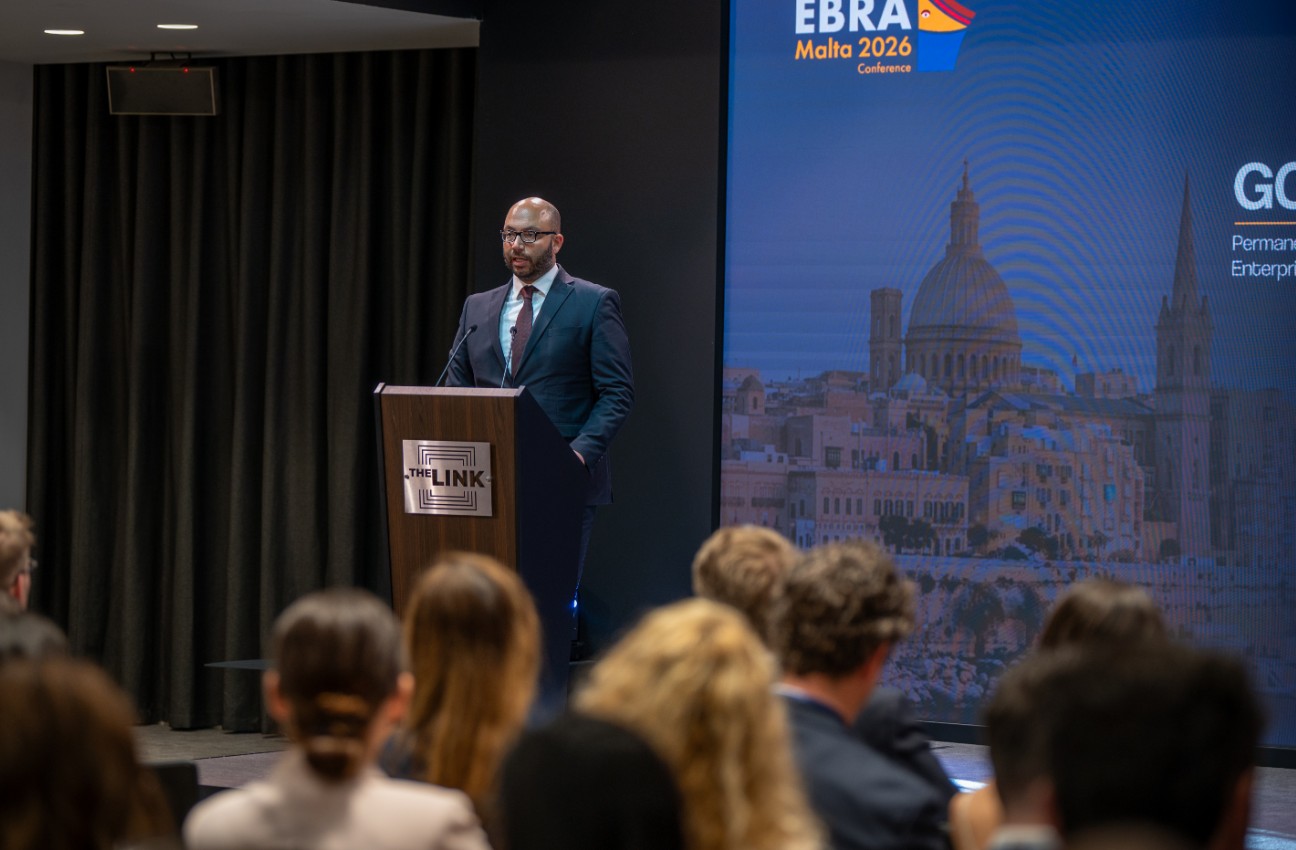
Permanent Secretary for the Economy, Enterprise and Strategic Projects Godwin Mifsud
He also referenced the Malta Business Wallet, a digital platform developed by the Malta Business Registry that allows businesses to securely store and share official documentation with government entities while maintaining GDPR compliance. The Malta Business Wallet is aimed at facilitating better compliance, which is something that the industry both wanted and need.
Another key discussion focused on the role of business registries in combating money laundering and terrorism financing.
During one session, delegates were asked whether pressure on registries in this area had increased over the past five years. According to the poll results presented during the conference, 99 per cent of attendees agreed that it had, with many identifying resource limitations as one of the sector’s biggest challenges.
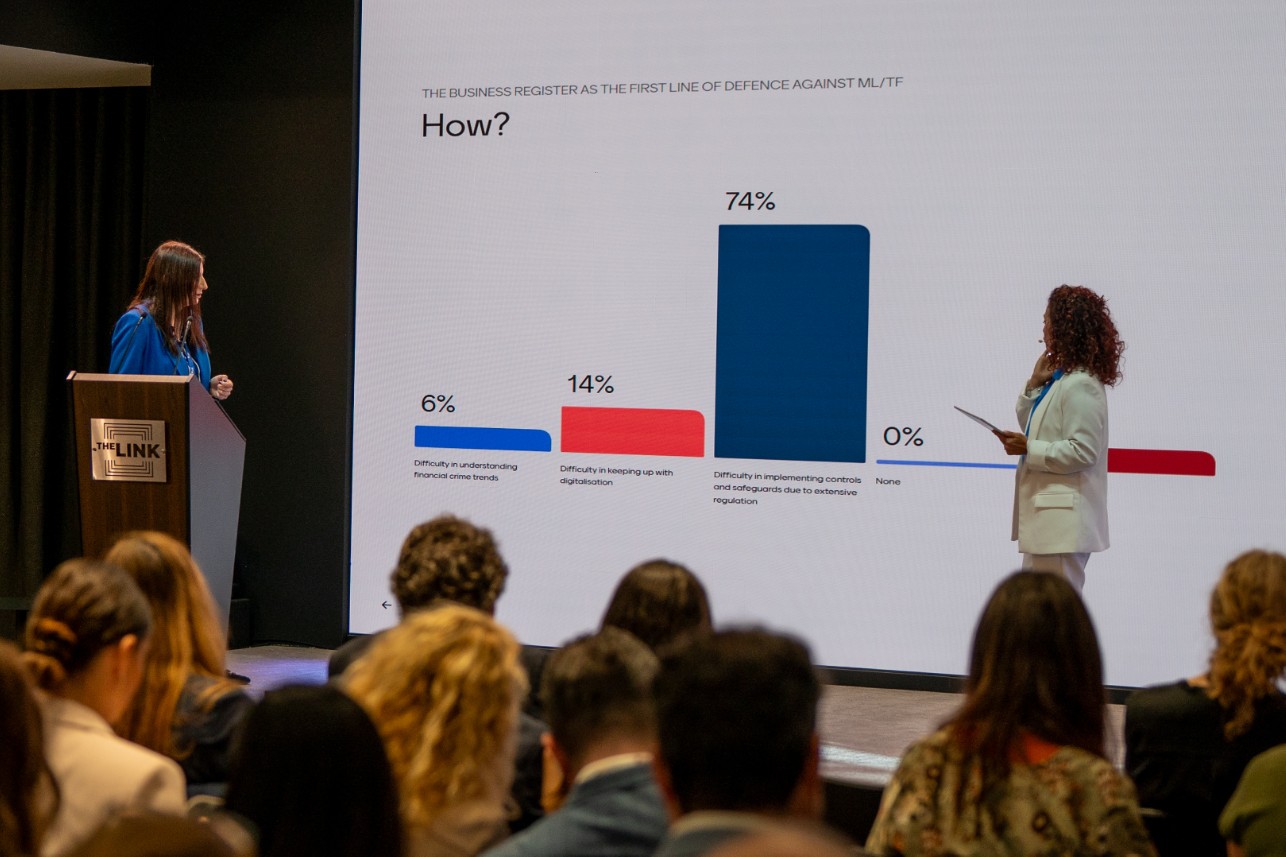
Reflection on the results of one of the polls
The conference also featured a presentation by Deputy Head of the Financial Crime Unit in the European Commission’s Directorate-General for financial stability, financial services, and capital markets union Claude Bocqueraz, on the European Union’s implementation of the Sixth Anti-Money Laundering Directive.
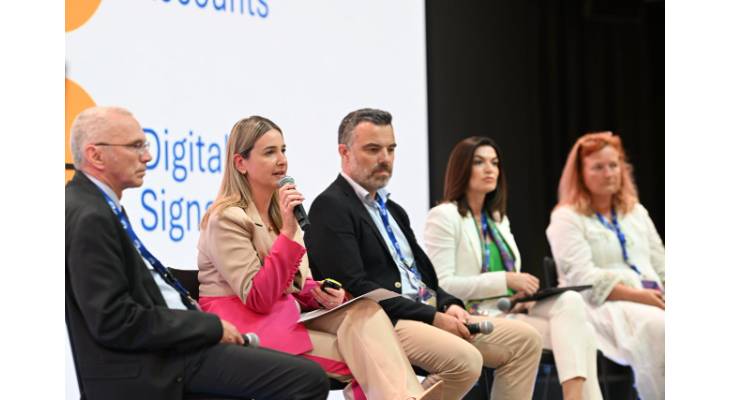
She explained that the EU has now entered the implementation phase of the legislation, with the real challenge lying in how effectively the framework works in practice ahead of key deadlines in 2027 and 2029. Among the measures highlighted were increased harmonisation across member states, an expanded scope of regulated entities, enhanced supervisory obligations, improved data management systems and new centralised mechanisms linked to cryptoassets.
She also noted that while the EU has made significant progress in strengthening its regulatory framework, implementation remains the biggest shared challenge across member states, particularly as authorities work to eliminate inconsistencies and improve cooperation across borders.
Other notable speakers at the event were Sebastian Drosselmeier (Policy Officer at the European Commission), and David O’Sullivan (EU Sanctions Envoy).
Additional professionals who also spoke at the event represented organisations like UK Companies House, the Association of Registers of Latin America & the Caribbean, Bundesanzeiger Verlag, InfoCamere, and more.
All in all, if you are a registry professional, this was the place to be.
Main Image: