In the fast-paced world of technology, one thing remains constant, according to Reuben Muscat, the Operations Director of software company, 2iLtd, a company assisting clients to integrate digital processes and standards: the imperative of prioritising talent, and the people whose hard work drives the growth of the business.
“Software companies like ours have no tangible assets; our assets are our employees, so our software engineers, support staff, and administration are at the heart of what we do. Our greatest advantage is the knowledge our team brings,” he says, adding that the focus of management is, indeed, to foster a fertile working environment within the business. “As much as we plan for strategic direction, financial success and profitability, our human capital is the foundation of any business success.”
Such attention to creating a productive and inclusive culture at 2iLtd – which boasts an office in Malta with 18 staff and a base in Serbia – has reaped its rewards. Indeed, Mr Muscat confirms that the average retention rate for staff is 10 years, with very little employee turnover.
“Nurturing an equitable and respectful environment is something we work on daily. The tech sector is, typically, characterised by a huge churn of employees, who move around constantly, with companies complaining that they cannot find the right people. While this does present a challenge, there is a solution. You need to have the right mindset to think about what can be done to retain your talent and, then, you need to work hard to achieve those results.”
In the tech sector, specifically, maintaining the integrity of the team is also crucial to the retention of knowledge. “Over the course of several projects, a developer – or a team – would have acquired plenty of know-how that cannot be easily replicated. The code itself, of course, can be read and understood. However, the business processes, the relationship with the client, and the way the project has evolved – that understanding is irreplaceable and would take a long time to fill.”
To this end, Mr Muscat advocates for a multi-pronged approach to attracting and retaining talent. “I would say that the journey starts from the first day of the recruitment and selection process. I am very selective. Sometimes there are positions we need to fill but I don’t place any pressure on ourselves to choose any person within a specified time. It has to be the right person, and if I have to wait and move things around till that position is filled with the right candidate, then so be it,” he explains.
He also believes it’s fundamental to “select people with the right culture fit. There are certain traits within a company that characterise the working atmosphere. This doesn’t mean we employ people who have the same skills, but we find complementarity, to create a certain chemistry so that there are people who work well together and share their views in a professional manner. This is about selecting the right combination of people to bring things forward quickly and efficiently, where everyone is a catalyst.”
The Operations Director also firmly believes in the “psychological contract” that the employee mentally makes with the company, a mindset that fosters a sense of loyalty. “As a team member starts to work and bind themselves with the business, respecting other colleagues, and fitting in with their other peers, there develops a form of silent contract of commitment. This binds the employee to the organisation,” he highlights.
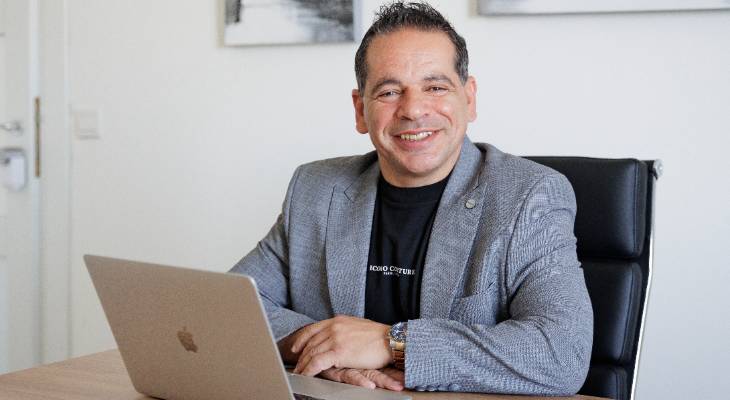
Operations Director Reuben Muscat
Elaborating, he says that “this is not about salary, and it’s not something that can be signed. It’s more intrinsic than that. Rather, they start to sense a togetherness, in that they are part of a team which shares the same values and that pulls the same rope. This is why I like to involve the team at the very inception of each project – so that they feel a sense of ownership and understand the context of the brief,” Mr Muscat explains.
When this psychological contract loosens, he warns, “trouble brews and the role of managers is to pre-empt this from happening. I am very sensitive to HR issues, and the moment I notice a shift, a red flag, I start addressing it immediately”.
Mr Muscat also insists on the imperative to focus on individual team members’ needs. “People are not robots, so it helps to approach everyone with empathy, to keep an eye on who may be underperforming and who might need help. Employees appreciate the care. I also believe it’s vital to create an effective work-life balance, without overloading our employees,” he insists.
This is also due to the particular nature of the job, he continues. “Software developers are highly intelligent; they are people fulfilling tasks which can be thought of as a mix of both science and art; they work with our clients, understand their digital transformation journey, and convert their ideas into systems and software solutions. So, we cannot just give them a list of tasks they need to follow. We involve them at every step, creating a sense of involvement and engagement,” he reiterates.
Part of this mindset is ensuring that the hierarchy of the organisation remains flat, he states. “I don’t believe in titles and ranks. When you say senior, that’s senior relative to what? Rather than focus on establishing some sort of order, I prefer to emphasise people’s particular skillset. Each software developer has their own sphere of expertise, and this is evolving all the time, as we continue to grasp the changes happening in the tech industry. In fostering such a flat hierarchy, I find its easier to encourage interaction and the sharing of expertise. I enjoy seeing my development team discussing solutions, and tools, while helping each other,” he attests.
Mr Muscat sees the role of human capital as becoming even more vital in an age where AI has quickly become ubiquitous, particularly in the tech industry, with 2iLtd taking a proactive role. “There’s been a lot of discussion around AI, with people feeling uncertain as to where it’s going to lead us. Within the company, we decided to play around with the technology, seeking to understand programmatically how we can use it. For approximately a year and a half, our staff were given a blank piece of paper to experiment with the technology,” he says.
This energetic perspective inspired some employees at 2iLtd to even embark on completing their masters in AI, Mr Muscat attests. “These employees are also bringing value to the company in this sense. So, we now have a bit of a structure, we are starting to understand our clients’ appetite for the technology, and we’re also applying for public funds to develop an AI strategy. We’re not afraid of what AI will bring but we see it as an opportunity, to give some more impetus to our developers and to inspire them to apply AI solutions to our client offering,” he says.
Ultimately, he continues, “what we are doing today, within tech, is not what we were doing 10 years’ ago, irrespective of AI. Every company has to adapt and change. We see the role of software developers evolving, but this has always been the case,” he explains. Nonetheless, he insists concluding, “the human being must stay on top of the technology, using AI as a tool, and if that remains the case, our gains will be significant.”
Main Image: