Foreign-controlled enterprises make up just 2.6 per cent of Malta’s business units, yet account for 62 per cent of total value of output, highlighting their disproportionate role in the country’s business economy.
Latest figures from the National Statistics Office (NSO) show that the number of business units in Malta’s non-financial business economy increased by 5.3 per cent, from 55,033 in 2023 to 57,970 in 2024 — an increase of 2,937 businesses.
Total employment also increased by 5.8 per cent, although the growth was driven by locally controlled businesses. Employment among Maltese-controlled enterprises rose by 7.4 per cent, while employment among foreign-controlled enterprises fell by 1.1 per cent.
Employee benefits expense rose by €659.2 million to €6,330.2 million, with foreign-controlled enterprises recording an 8.0 per cent increase despite the slight decline in employment.
Gross investment in tangible non-current assets across the economy increased by 39.4 per cent in 2024, driven by a 99.8 per cent increase among foreign-controlled enterprises. Investment among locally controlled enterprises, by comparison, declined by 7 per cent.
Despite accounting for only 2.6 per cent of Business units, foreign-controlled enterprises had the larger share of net turnover, value of output, gross operating surplus and gross investment in tangible non-current assets.
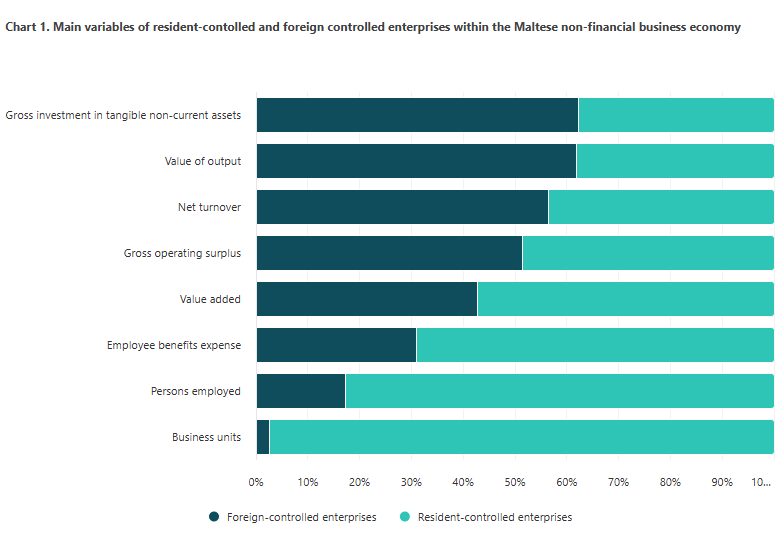
The figures underline the significant economic weight of foreign-controlled businesses, which represent only a small proportion of the total number of enterprises operating in Malta.
Foreign-controlled Small Mid-Cap (SMC) enterprises numbered 19 in 2024, down from 23 a year earlier. Despite their small number, they generated €522.4 million in value added, equivalent to 8.2 per cent of total value added among foreign-controlled enterprises.
SMCs recorded declines across all measured variables except gross investment in tangible non-current assets.
European countries, including both EU and non-EU Member States, accounted for 74.6 per cent of foreign-controlled enterprises in Malta’s non-financial business economy.
Non-EU Member States controlled 860 business units, representing 57.3 per cent of all foreign-controlled affiliates.
Among non-EU Member States, enterprises controlled from Europe recorded the highest value added, gross operating surplus and employment, generating €1.74 billion in value added, €1.29 billion in gross operating surplus and employing more than 9,000 people.
The UK, Italy, United States and Germany remained the countries controlling the largest number of foreign affiliates in Malta, with a combined 562 business units, 42 more than in 2023.
Asian-controlled enterprises also recorded strong growth in net turnover, rising from €3.97 billion in 2023 to €5.20 billion in 2024.
Enterprises controlled from America, meanwhile, recorded declines in both employment and value added, falling by 27.6 per cent and 17.2 per cent, respectively.
The NSO figures paint a picture of a Maltese business economy that continued to expand in 2024, but with a striking concentration of economic activity among foreign-controlled enterprises.
Main Image: