Originally from Finland, Captain Jesse Jaalinna always knew he wanted to work onboard ships – he just didn’t know which type.
At the age of 16, after finishing compulsory school, he applied to attend maritime college. He then got his first position on a boat, and after a few years working in the industry returned and got his deck officer's permit.
In 2009, he did his Masters qualification, which is the prerequisite to become a Captain.
He worked onboard various vessels for 20 years, serving on yachts of between 50 metres to 95 meters, with crews of between 13 to 33 people.
Capt Jaalinna now works as a lecturer at one of Malta’s leading maritime schools, MaritimeMT, and he sits down with WhosWho.mt to discuss the yachting industry, why people join it, as well as what it offers.
Why join the yachting industry?

Illustrative image: Yachts at port in Malta
There are a number of reasons why individuals might aspire to join the yachting industry – though Capt Jaalinna says this is a sensitive topic, as he doesn’t want to make the industry appeal to people for the wrong reasons.
However, he does concede that a major factor is that the industry offers financial stability, no matter your background. This means, he says, that it will almost always see employees making above what they would be making in a shore-based position.
Aside from the financial element, there is also the opportunity to travel, which appeals to many: “You travel across the world while earning,” Capt Jaalinna says.
Additionally, in terms of qualifications entering the industry is appealing. For an entry-level position, for example, the mandatory training takes weeks, rather than months, meaning it can appeal to school leavers and those switching careers.
For higher positions – deck officers and captains, studies take only three to four months, and open up a career path that could, with the relevant experience and network, see graduates making five figures a month.
“However, money definitely shouldn’t be an applicants’ only reason to enter the industry, and it is important that yachting professionals also have a passion for what they do,” he clarifies.
Overall, Capt Jaalinna concludes, “what the yachting industry offers is financial stability, relatively fast academic requirements, and the opportunity to travel the world while earning.”
What qualifies a person to enter the yachting industry?
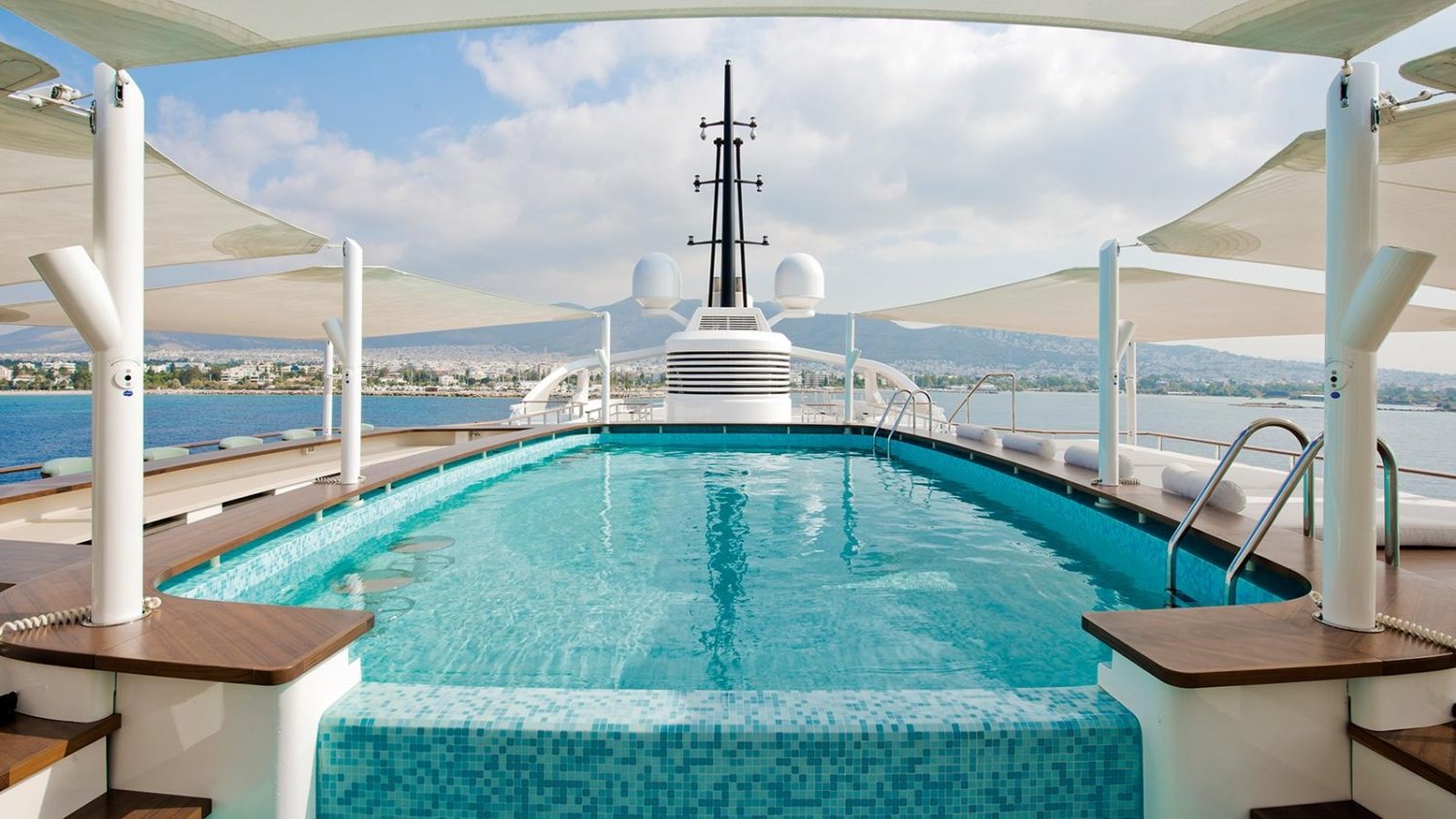
Illustrative image: A swimming pool features prominently on Malta-flagged superyacht, 'Dream'. Photo from Superyachtfan.com
There are plenty of interchangeable skills required to work on a yacht. In the words of Capt Jaalinna, it’s like a miniature society, filled with people that have normal life needs. This includes for hygiene, healthcare and food along with other, more niche fields – there have even been recent adverts for drone operators to work on yachts for example.
Thus, Capt Jaalinna explains, individuals with existing qualifications in these sectors can be well-positioned to be valued in the field. He adds this is especially the case for traditional trades, like carpentry. Good carpenters, he says, are like gold flakes.
Specialists in those fields could be attracted to the extra challenge of excelling in their specialty areas, but on a yacht and Captain Jaalinna reminisces that while it is no longer considered ‘politically correct’ to say, there used to be a saying amongst recruiters for jobs on yachts: “If you haven’t done it on a white boat, you haven’t done it.”
Those already in the maritime industry and considering joining the yachting industry are also considered to be promising candidates, although there are adjustments required for working on a yacht. “After all, every yacht is a ship, but not every ship is a yacht,” the Captain says.
These individuals can expect to learn on the job, and rise up the ranks on board a ship. Once they do so, Captain Jaalinna proclaims, “they've made it, and there’s no going back.”
Even those just starting out with their careers have value to the maritime industry, and could enter yachting though, and he’s keen to clarify that attitude is the most important thing, as anyone with the right attitude can learn the required vocational skill and thrive.
How does one enter the yachting industry?

Illustrative image: Malta-flagged exploratory superyacht Scenic Eclipse
The yachting industry is considered to be highly exclusive – though Capt Jaalinna tries to avoid calling it underground.
A lot of yachts function as floating second homes for high net worth individuals, and Capt Jaalinna points out that much in the same way as Queen Elizabeth’s staff don’t post on Instagram what they do at work, yacht staff are also not expected to publicise their work in this way – meaning it largely flies under the radar.
There is a particularly notable exception, however, in the form of the reality TV show ‘Below Deck,’ whose most recent series was filmed in Malta. While he acknowledges that the show does seem to be scripted, he states that nonetheless, it gives a good idea of what one can expect from working in the yachting industry.
The challenge this poses for those looking to enter the industry, and indeed those looking to rise within it, is the need to have a network.
“You may have the most beautiful CV in the world, but it could be toilet paper as far as the industry is concerned – if you don’t know the right people,” Capt Jaalinna explains.
To make up for this then, he adds, individuals should work to make sure they’re networking from day one of their time in the industry – whether it be in a classroom, yacht shows, or on the deck.
Aspiring mariners can try classrooms or yachting schools in general, as well as marinas (including crew bars and any possible dock parties), yachting events, boat shows and crew houses for other opportunities, he says.
For entry-level jobs, naturally networking is much less of a requirement, but anything above these positions it likely will be. This is because, as the Captain reflects, the skills needed to excel in the industry can not always be evidenced from a CV, but need anecdotal backing up by other reputable industry figures.
This networking does not need to be a massive challenge, though, especially in the digital age, and even something as simple as participating in online forums can be a help.
Aside from networking, it is also necessary for aspiring yacht professionals to gain the prerequisite qualifications relating to compliance and international regulations. “Even if you’re a Michelin-starred chef, you cannot just be brought onboard a yacht without the appropriate qualifications,” Captain Jaalinna says.
After getting qualified though, individuals can be considered for positions in the industry all over the world, from Miami to Malta.
This requirement for basic training is so in demand that MaritimeMT offers it on a monthly basis.
What does MaritimeMT offer?

Some of the facilities available to MaritimeMT students
As one of Malta’s foremost maritime schools, MaritimeMT can help those aspiring to enter the industry gain the necessary qualifications to do so.
With respected lecturers such as Capt Jaalinna , students will leave having gained valuable insights into the inner workings of the industry, as well as the technical aspect of their positions.
No two lessons are the same, and Capt Jaalinna reflects that in one given week, there can be in one classroom with students learning how to navigate via the stars (a compulsory module, even in the GPS era), another with students learning about the niches of international regulations, another training stewards and stewardesses on firefighting, and a final with engineers calculating generator yields.
“That means that at one moment, you have one class studying maps of the stars, one fighting a live fire with breathing apparatus on their backs, one reading about international law, and another developing their maths skills,” Capt Jaalinna laughs.
Main Image: