For the past 125 years, the name ‘Maypole’ has been synonymous with Maltese bread and freshly-made baked goods.
Even amidst the market, financial and societal transformations of the past century, the food and confectionary provider – dating back since 1900 and today a consolidated Group boasting a Artisanal-industrial Bakery and food manufacturing in Handaq, 3 resturantants and 32 retail outlets across the Maltese islands – has been intent on solidifying its position as a heritage company embedded within local communities and serving village needs, Reuben Debono, the newly appointed CEO of the Group, has said.
“Our business model is unique in Malta [within the food manufacturing, distribution business and retail] for when we speak of Maypole, we are not simply referring to the retail shops we’ve opened over the years, but we also speak of baked goods, and, principally, of Maltese bread, our ħobż, Mr Debono smiles.
Indeed, he continues, “the heart and soul of Maypole revolves around this traditional provision and we know that, today, our customers still come to our shops for that bread. Then, of course, their experience is augmented by third party products which compliments our offering but our unique selling proposition – one which no other competitor has – is linked to our heritage as bakers and food manufacturers and the genuine love for this humble yet important product in our daily lives.”
Concomitant with such a legacy, the strategy of the firm has always been to remain close to the communities it serves. “Our philosophy is to understand our customers and to serve them with authentic products of high-quality. Our strong suit is that we build long and lasting relationships. Our customers know that whatever they need, for whatever occasion – whether its bread for school lunches, or a celebratory cake and some pastries – we’re on hand to help. We are there every step of the way and we want to participate in those small and big moments of a person’s life,” the CEO states.
Elaborating more broadly on the Group’s competitive advantage, Mr Debono stresses that authenticity in business has been crucial to its success. “With us, what you see is what you get. We are not a faceless corporation. We’re very accessible and we have a strong marketing and customer , which includes our retail workers who come face-to-face with our customers on a daily basis. We also have an added advantage in that we have full visibility of each end of the supply chain. In other words, from the flour in our stores to the bread on our shelves, we know the provenance of each and every single element. This means we control its quality, freshness and the service we provide – and this is only possible through our people on the ground,” he attests.
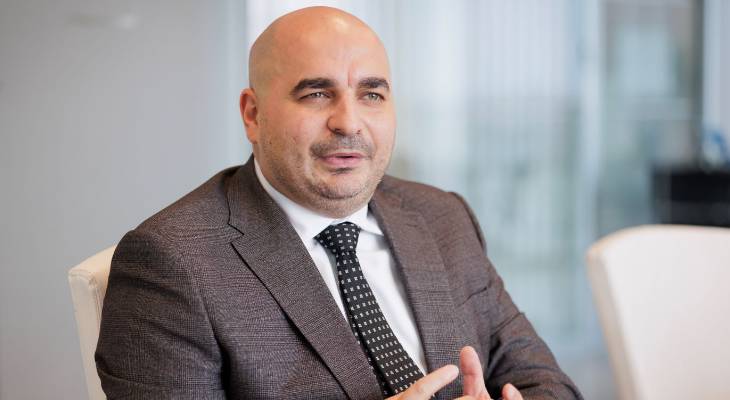
Reuben Debono, Maypole Group's newly appointed CEO
Today the Group employs approximately 750 people, with 300 involved in its food manufacturing arm, 350 team members working in their retail shops, 50 Horeca and 50 operating within the management and administration side of the business. The company has also modernised over the years, albeit while also retaining their commitment to traditional approaches. “We still have on-site bakers who knead the bread, but we are also incorporating technology within the process to preserve the craftsmanship of our heritage, rather than replacing it. We cannot forsake the human touch and it’s that baker’s skill that gives soul to these very humble products,” he says.
To this end, technology is being principally used to augment business operations. “We are harnessing digitisation to give more meaningful jobs to our team: for instance, part of our task is collecting data and analysing it to make business decisions. If AI can do the dirty work and give us the information we need to be more agile in responding quickly, then we’ll use those tools at our disposal. Everyone is talking about AI as the fourth industrial revolution – as if it’s the end of civilisation – but innovation is crucial to our strategy moving forward.”
Elaborating on the gaps in human resources being faced by Malta's business community, Mr Debono explains that "thanks to our wider HR strategy and our continuous investment in people, we have maintained an 85 per cent staff retention rate. Nevertheless, challenges persist, particularly the difficulty in recruiting skilled workers. There’s a shortage of labour across the board and, more specifically, in certain trade roles, where the situation is acute as younger generations shift away from these industries. To help address this skills gap, together with Saint James Hospital and Saltwave Limited, we have established the European Vocational Academy. The academy was created to revive and strengthen vocational education, and our programmes are delivered in collaboration with the City of Glasgow College," Mr Debono highlights.
The Group also “feels a duty of care”, the CEO says. “We’ve partnered with the Richmond Foundation to provide support to those of our team who may need a little bit more at difficult times of their lives. Ensuring inclusion of our workforce – many of whom are third-country nationals – is also a priority since without them we cannot operate. So, we welcome them, we organise activities for them to feel part of our family, and we have also organised Maltese language courses for them, in partnership with the University of Malta. This helps them understand us, and equally important helps us understand them. It has also had a positive effect on our customers at large, for when you see a foreigner speaking in Maltese, you immediately feel a connection.”
Looking ahead, Maypole Group is keen to capitalise on the value it has accrued over the decades. Indeed, it has planned an expansion of its product lines and is preparing to widen its offering into B2B services and, potentially, foreign markets. However, each decision is carefully weighed before implementation.
“This is the case even if or when we decide to open a new retail shop: we always make sure to conduct our market research, including a data analysis of the figures. We never expand just for the sake of it, and we never compromise on quality. Instead, we look at how the communities are also evolving and how their needs are changing. It always boils down to the data at hand. This helps us make informed decisions,” the newly appointed CEO concludes.
Main Image: