Design studio Mattermake grew out of an awareness of the potential inherent in digital fabrication says the firm’s founder Steve De Micoli. Indeed, his studies in London led him to understand the transformative possibilities of a process where a digital model is actualised directly into a physical object.
“I had seen the potential of dropping those borders between what’s happening on paper, and the materialisation of your idea. “Digital fabrication allows the act of making to become an integral part of the design process, where materials, tools and fabrication methods actively inform and evolve the design as it is produced.”
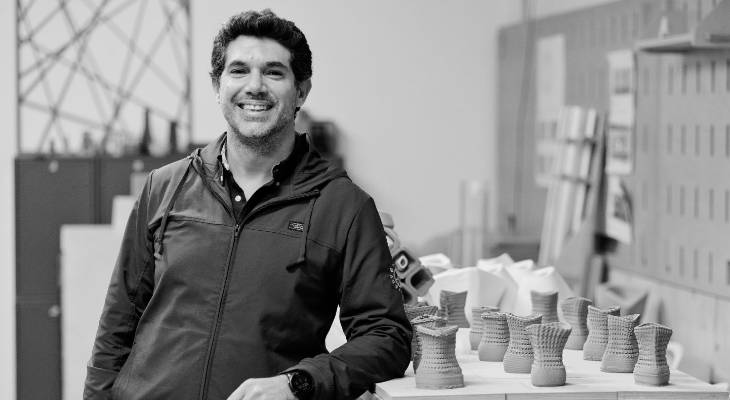
Steve Demicoli, Mattermake Founder
This inextricable link between material and creation is tied more holistically to Mattermake’s business philosophy. “The idea of ‘matter’ also has a broader meaning in terms of relevance: does this matter? What we make matters, and the projects we have been working on are those we have intentionally chosen to accept or to create,” explains Mr De Micoli.
Crucially, since its establishment in 2009 – initially under the auspices of architecture firm DeMicoli & Associates and operating under the name of DFab Studio until 2019 – Mattermake has been driven by innovation and a curiosity in exploring the intersection between designing and making. To this end, some of its projects have been focused on integrating new processes and materials within a directly commercial commission, with the business operating within the bespoke joinery market.
Previous projects include the reception desk for Spinola Terraces which consisted of a free-form organic structure made from steam-bent walnut that was generated using a 3D model, and forged using the studio’s robotic machinery. Moreover, the ceilings, walls and counter area in Manouche, in St Julians and Paceville, were also fabricated at Mattermake, based on digital designs created by the firm’s team.
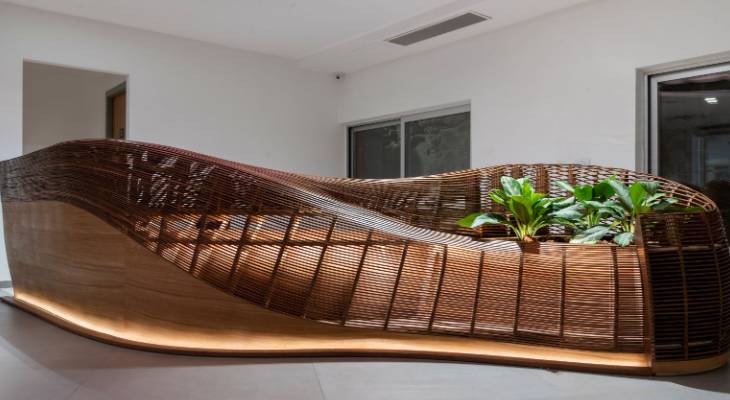
Th reception desk at Spinola Park, designed and fabricated by Mattermake
“We have two core departments. One is our interior & architectural design department, which oversees and completes our architectural commissions. In these cases, being an acting lead architect at De Micoli & Associates, we often collaborate as well as other third-party designers. We then have our fabrication department, which works closely with our designers,” the founder highlights.
Over the years, the company’s structure evolved to become the firm’s unique selling proposition in that “we can speak the language of designers and architects, but we also have that technical knowledge to know how to materialise creations. We possess a wide range in terms of skillset,” he says.
The physical space housing Mattermake has also been vital in this respect: the company is situated across two floors in a warehouse in Burmarrad, where the ground floor is dedicated to a 650-square metre workshop, with the first floor comprising a large, open-space office and maker space.
Such a working proximity has meant that collaboration across the typically partitioned conception and manufacturing arms of the business can flourish. “It’s rare to have an interior designer talking to a master carpenter so closely, and for them to be working within the same space, as they do at Mattermake,” Mr De Micoli asserts.
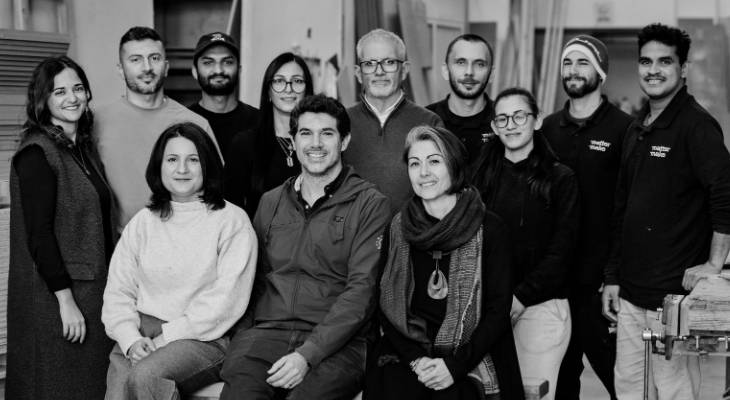
The team behind Mattermake
As a result, while the team are “design-led”, they are “trained to look at a project holistically”, the founder continues. “We approach any job within the context of the entire assignment, and we’re conscious of how the other trades work. What this means is that, if we see an issue or a conflict, we highlight it, since we’re also geared to see the bigger picture. This is something we take pride in. And, I think our clients know this, and see that we genuinely care. This means we seek to build long-term relationships with clients and share their interest.
In addition, and fundamental to Mattermake’s approach is its investment in research and development. “[The author and speaker] Simon Sineck had said that ‘profits equal freedom’, so the first thing we had to do, as a business, is to make sure we could stand on our two feet, financially. Thankfully, we are now at a point where we can start to push our design, material and manufacturing experimentation more, while also spearheading R&D. This takes a lot of resources. However, we now have a body of work which we can build upon to continue pushing the boundaries of our curiosity,” the founder explains.
Elaborating, Mr De Micoli describes a recent residential commission, where a client requested the design and manufacture of a home cinema. The screening room was crafted as a landscape, with sculpted seating, upholstered to maximise comfort and featured integrated lighting, sound and vision. The project won several awards including the Big See Interior Design Award, 2025 – which commends work produced across Southern and Eastern Europe – the Malta Architecture and Spatial Planning (MASP) Small Projects Award, given under the auspices of the island’s Planning Authority and the German Design Award.
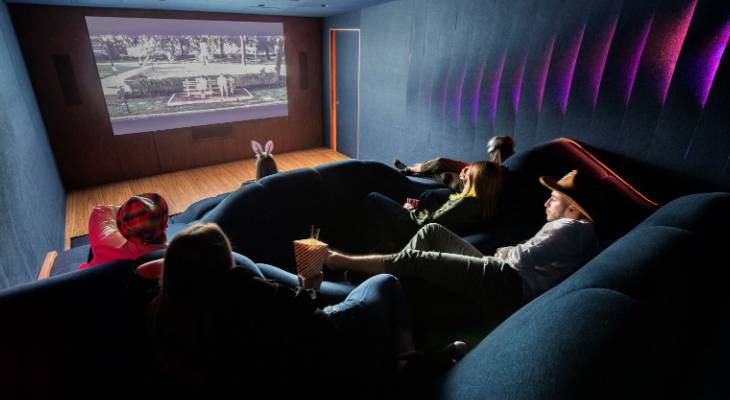
Cinema Visiona by Mattermake
Moreover, the firm has also been responsible for the creation of the reception feature reception desks at the Brewhouse and Spinola Park. The former of which involved a manufacturing technique called incremental sheet forming, which involved the forming of double-curved copper sheets without using costly moulds. “It’s that level of experimentation – similar to that you’d find in architectural school – which drives us, and which is fundamental to our practice,” Mr De Micoli attests.
In this way, the firm hopes to leave a lasting impact on the local architectural and design sector. “I think we move with our heart, and we make decisions based on what gets us fired up – on what we’re able to and what we know we will be able to figure out, in our small way, to make the world a better place. In this respect, the team is a convergence of like-minded people,” he says, explaining that the business has taken on projects driven by a social and community ethos.
“For example, we have just finished submitting a project for an international competition to design a kindergarten. We used modular timber pre-fab, basing our concept on cutting-edge school pedagogy and thinking about how the building itself can also be a teacher,” Mr De Micoli explains.
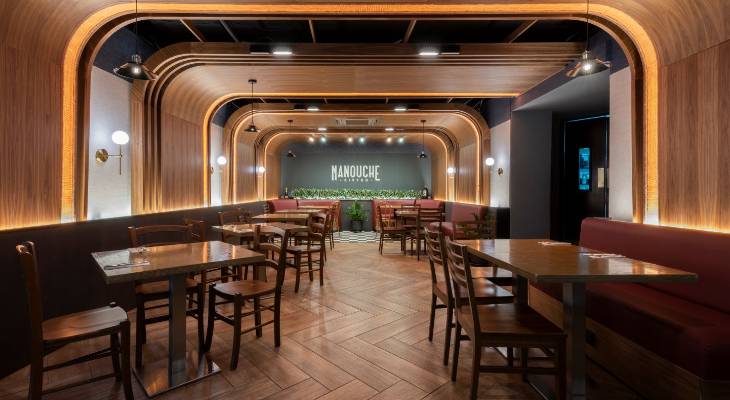
The interiors at Manouche, Paceville
Furthermore, Mattermake is also involved in an artificial reef project, in collaboration with Żibel, the environmental NGO, as well as Adi Associates, an environmental consultancy company. “For this, we’re developing the scientific research, while designing and manufacturing the prototypes which will be placed in the water. Once it goes in, we’ll start to record the results, with the aim of developing artificial reef systems to help increase biodiversity on sandbanks,” Mr De Micoli outlines.
Looking ahead to the next few years, the focus will continue to be on “servicing the bespoke joinery market but also pivoting to more design-led ideas.” Fundamentally, for Mattermake’s founder, the business’ work will be rooted in attempting to “instill a sense of wonder. For our cinema project, we were inspired by the act of watching a film or television as a child, where you sit on a couch designed to be 3 times your scale, and you find new creative ways of comfort. We wanted to bring across that feeling of nostalgia and playfulness – and this approach will continue to be what inspires our work as we move forward,” Mr De Micoli smiles, concluding.