As people are becoming more aware about sustainability and conversations around the subject intensify across industries, Keith J. Caruana, Leather Artist and Founder of Captain’s Cut, believes the leather sector requires not only better materials but also stronger public policy incentives to encourage repair, responsible sourcing, and the positive reinforcement of truly Made in Malta items backed by genuine expertise.
Speaking to WhosWho.mt, Mr Caruana emphasises that sustainability in leather goes beyond marketing claims and begins with education, material quality and long-term product value.
One of the most pressing issues, he argues, is the growing culture of disposability.
“We are seeing a lot of repairs and this repair business is increasing,” he says, noting that more consumers are approaching artisans to fix bags, belts and accessories rather than discard them, but in most cases this cannot be done due to the inferior materials.
However, he believes governments can play a stronger role in positively reinforcing repairs, sustainable materials, the expertise behind Made in Malta craftsmanship, and high-quality goods by making it very clear even in national curricula that "plastic is not fantastic."
In France, a national repair bonus scheme was introduced in November 2023, offering consumers direct discounts when they repair textiles and footwear through authorised repairers. The initiative, led by the French Government, applies an immediate reduction to repair invoices – for example:
- €8 for sewing or gluing work on shoes
- €7 for patching a tear in clothing
- €10 to €25 for replacing garment linings
The discount can cover up to 60 per cent of the repair cost, provided the total repair exceeds €12.
Mr Caruana believes similar schemes could support artisans locally and reduce waste.
Mr Caruana also raises the issue of imported components, such as buckles and hardware.
“When we import a high-end buckle there should be an incentive for solid metals so people won’t be paying more money for it,” he says, suggesting that fiscal structures could reward durability and quality rather than low-cost alternatives.
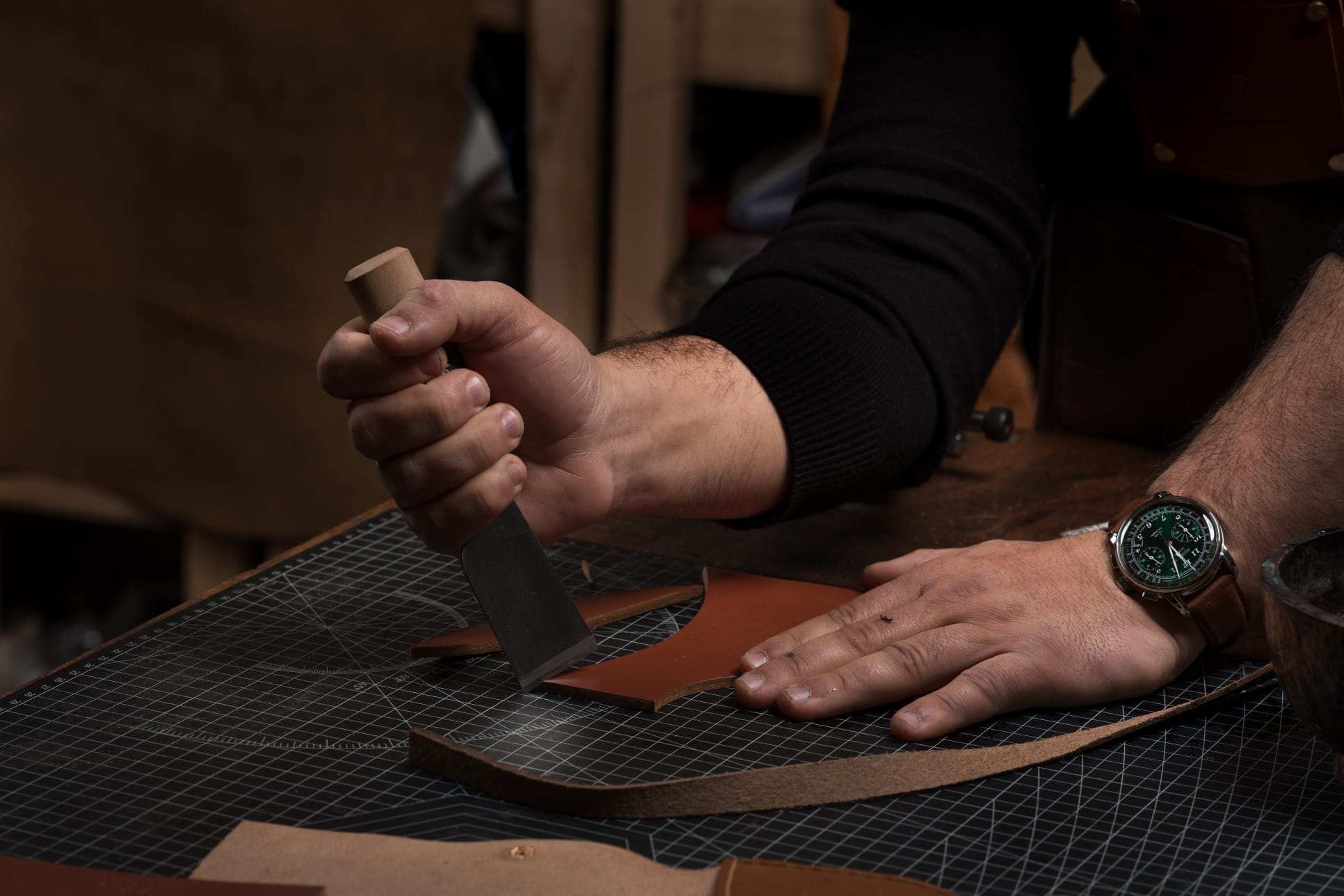
Keith J. Caruana working on a leather project photographed by Yana's Rabat
For manufacturers and retailers, the cost differential between solid metal hardware and cheaper plated or alloy alternatives often influences pricing decisions. However, the long-term environmental and reputational costs of lower-grade components may outweigh short-term savings.
Responsible sourcing and the meat industry link
On sourcing, Captain’s Cut works with sustainable tanneries and operates on the principle that no animal is killed for its skin.
“Cows are killed for meat so we have a responsibility to use that skin,” Mr Caruana says.
This view positions leather as a by-product of the food industry rather than a primary driver of animal slaughter. For sustainability-conscious businesses, this raises the importance of traceability and responsible tanning processes in reducing environmental impact.
The company also limits its operational footprint by using hand-operated machinery that does not rely on electricity, reducing CO₂ emissions in production.
Beyond materials, Mr Caruana expresses concern about the loss of artisanal identity in the pursuit of mass production.
“Some companies are going into mass production or trying to produce in places which are quite an eyesore and there is no concept of an artistic place. So you lose the experience. That needs to be done in a historic place,” he says.
He added that significant investment is placed in “the creative of the journey”, underscoring the value of heritage and craftsmanship in product storytelling – an aspect that can strengthen brand positioning in premium markets. "Fashion and art tourism can further help ateliers promote local artisans and heritage, drawing visitors to authentic experiences."
The ‘real leather’ misconception
A central point in the discussion was the widespread misunderstanding around the term “real leather”.
Mr Caruana compares it to plywood. Just as pieces of wood can be glued together and sold as wood, leather scraps can be processed and marketed under the label “real”.
Technically, genuine leather is derived from real animal hide. However, within industry grading, it represents one of the lowest quality tiers. It is typically made from the fibrous inner layers left after the top layer of the hide has been removed. It may be embossed with artificial grain and treated with polyurethane to improve its appearance.
In contrast, full-grain leather retains the natural grain layer – the toughest and most durable part of the hide – allowing it to age well and develop a patina over time.
Mr Caruana stresses that more consumer education is required.
“People should look for full grain leather,” he says, arguing that inferior grades not only wear out faster but often cannot be repaired – undermining sustainability claims.
For businesses operating in retail, manufacturing or importation, the distinction is commercially significant. Products marketed as “real leather” may meet consumer expectations of authenticity, but they do not necessarily deliver durability or long-term value.
As sustainability reporting and ESG scrutiny intensify, transparency around material quality and lifecycle durability may increasingly influence purchasing decisions – both at consumer and corporate levels.