Students took to the stage at HSBC Malta’s offices in Ħal Qormi this week, presenting business ideas, bake sales and student-led ventures as part of Global Money Week, turning financial literacy into a hands-on, and at times entrepreneurial, experience.
Organised by JA Malta in collaboration with HSBC Malta, the event brought together students from six schools, all forming part of the Centre of Excellence programme, which the Ministry of Education is a partner in. The projects showcased how financial education is increasingly moving beyond textbooks and into real-world application.
The event was hosted by Petra Ellul Mercer, Financial Capability Consultant at JA Malta, who guided students through their presentations.
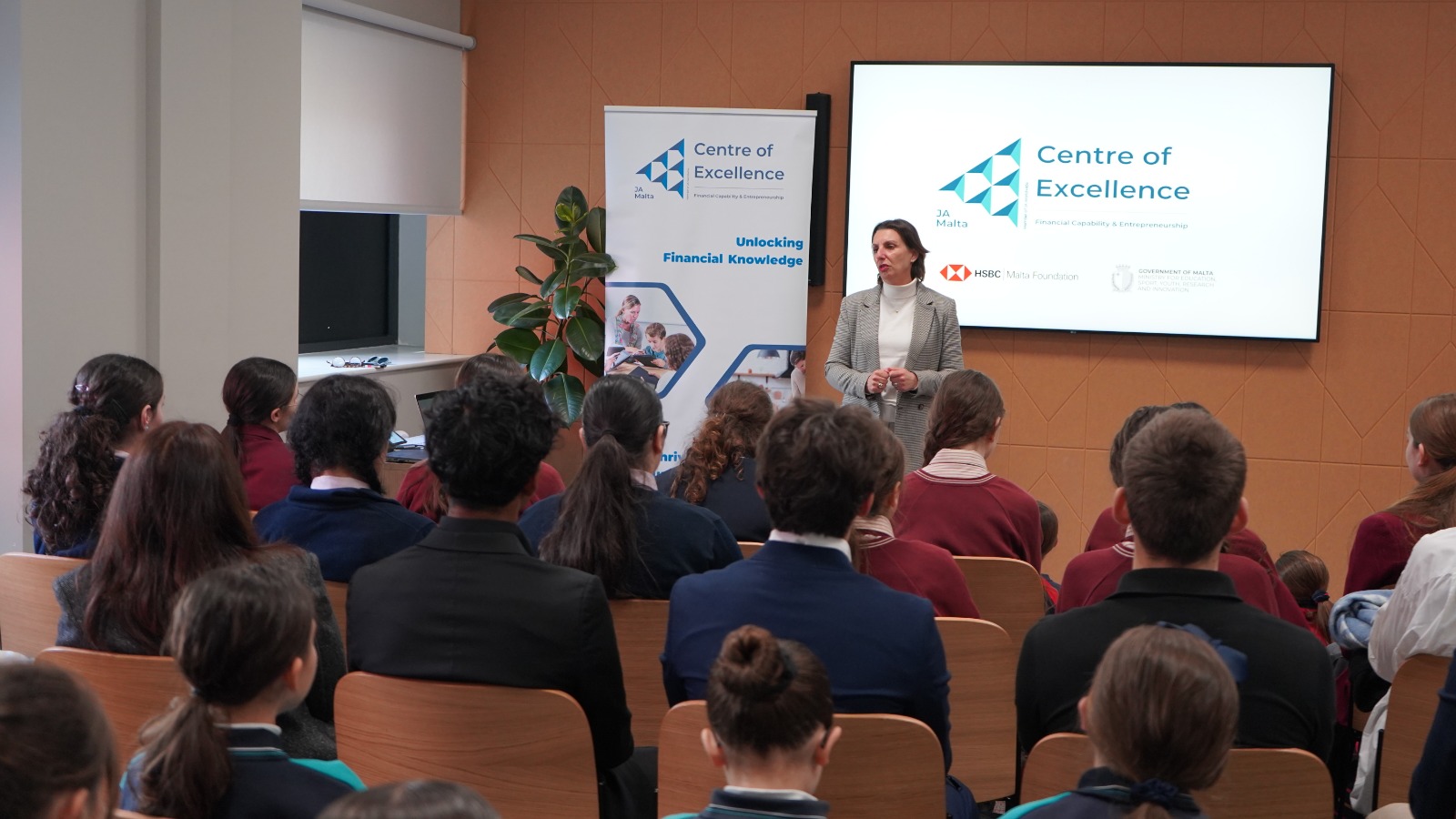
Petra Ellul Mercer addressing the students
Among the standout presentations was that of St Monica School in Gżira, where Form 5 students transformed classroom theory into practice through a cookie bake sale. Having first learned about profit calculation, cost classification and break-even points through integrated lessons across subjects, students organised themselves into teams and launched their initiative.
The result? A complete sell-out by the second school break.
Reflecting on their experience, they noted that future improvements could include product bundling – such as selling milk alongside cookies – to boost profits further. Proceeds were split between a donation to a school in Nigeria, contributions towards school operational costs, and personal savings so they can open their own bank accounts.
A financial manager at 10 years old
At San Anton School, students aged just 10 and 11 took on clearly defined corporate-style roles – including general manager and financial manager.
Working in teams, the students created and sold crafts produced during their free time and school breaks. Their efforts raised €3,000 across 25 teams, with funds earmarked for the restoration of a San Anton painting housed in the Church of Our Victory in Valletta.
They credited their success to careful planning, budgeting and cost control, while also acknowledging challenges in product design and marketing. Looking ahead, they expressed interest in diversifying their product range to increase appeal and sales.
Adapting to the market
Students from San Ġwann Primary School demonstrated another key business principle: adaptability. During their student-led Christmas market, they adjusted the pricing of their snowman products after noticing weak demand – a decision that ultimately improved sales performance. Profits from their initiative will go towards enhancing the school garden.
Similarly, St Michael’s School combined inclusivity with entrepreneurship. Their bake sale and Boroż ta’ San Martin initiative generated €110, with treats costing €5 to produce and selling for €7. Importantly, they also catered for gluten-free students. Proceeds will contribute to the creation of a school garden.
Building future investors and entrepreneurs
At Verdala School, financial literacy took on a more structured, long-term approach through the student-led InvestED Club. Founded and run entirely by students, the initiative aims to make financial education more accessible among peers.
Citing that 82 per cent of young people feel unprepared for adult finances, the club is organising daily 10-minute financial knowledge quizzes on a website they designed during Global Money Week. Students log in via an online platform, with the highest-scoring homeroom earning a pizza party (talk about an incentive!)
Meanwhile, St Catherine’s High School introduced “Scharks Tank”, a student entrepreneurship challenge inspired by real-world pitching environments. Students developed business ideas, designed branding, set pricing strategies and presented their concepts to a panel of judges.
Their efforts raised €100, which was donated to the Abandoned Animals Association (AAA).
With Malta’s upcoming ‘Intrapriża 16’ legal framework set to allow 16- to 18-year-olds to establish their own businesses, initiatives like this may soon extend beyond the classroom and into the real economy.
HSBC Malta gave participating schools €200 each to support their projects. The bank also opened its doors to students, offering its premises for future initiatives, along with mentorship opportunities.
Main Image:Verdala School students accepting the €200 donation from HSBC Malta, with a bank representative