When QP was founded in 1980, it was a small team of project managers delivering a landmark hotel development in Malta. More than four decades later, the firm employs some 180 people across six disciplines and works on projects stretching from the Americas to Shanghai. Yet, for Reuben Xuereb, QP’s core has remained constant. “Planning, strategy and execution are still what we do. What has changed completely is how we do it,” he says.
“The change reflects a built environment that has grown far more complex, with projects today involving a much wider range of stakeholders, regulations and technical requirements. Sustainability, compliance, technology and user expectations now carry a weight they simply did not have a generation ago. Clients expect more than technical competence,” Mr Xuereb explains. “People come to us looking for strategic guidance and certainty. Collaboration across many disciplines has become essential to whether a project succeeds or fails.”
Born into the construction industry, Mr Xuereb recalls playing with construction tools as a child, although his professional grounding came from finance. In 2006, QP was involved in a major development in Libya, the Tripoli Palm City Residences, where Mr Xuereb personally led the project’s financing before later being appointed CEO of the joint venture developing a luxury residential village. “It was about as hands-on as experience gets,” he says. “QP today is really the culmination of that experience and of everything we learnt about what can be done better, turned into a service built around what the client actually needs.”
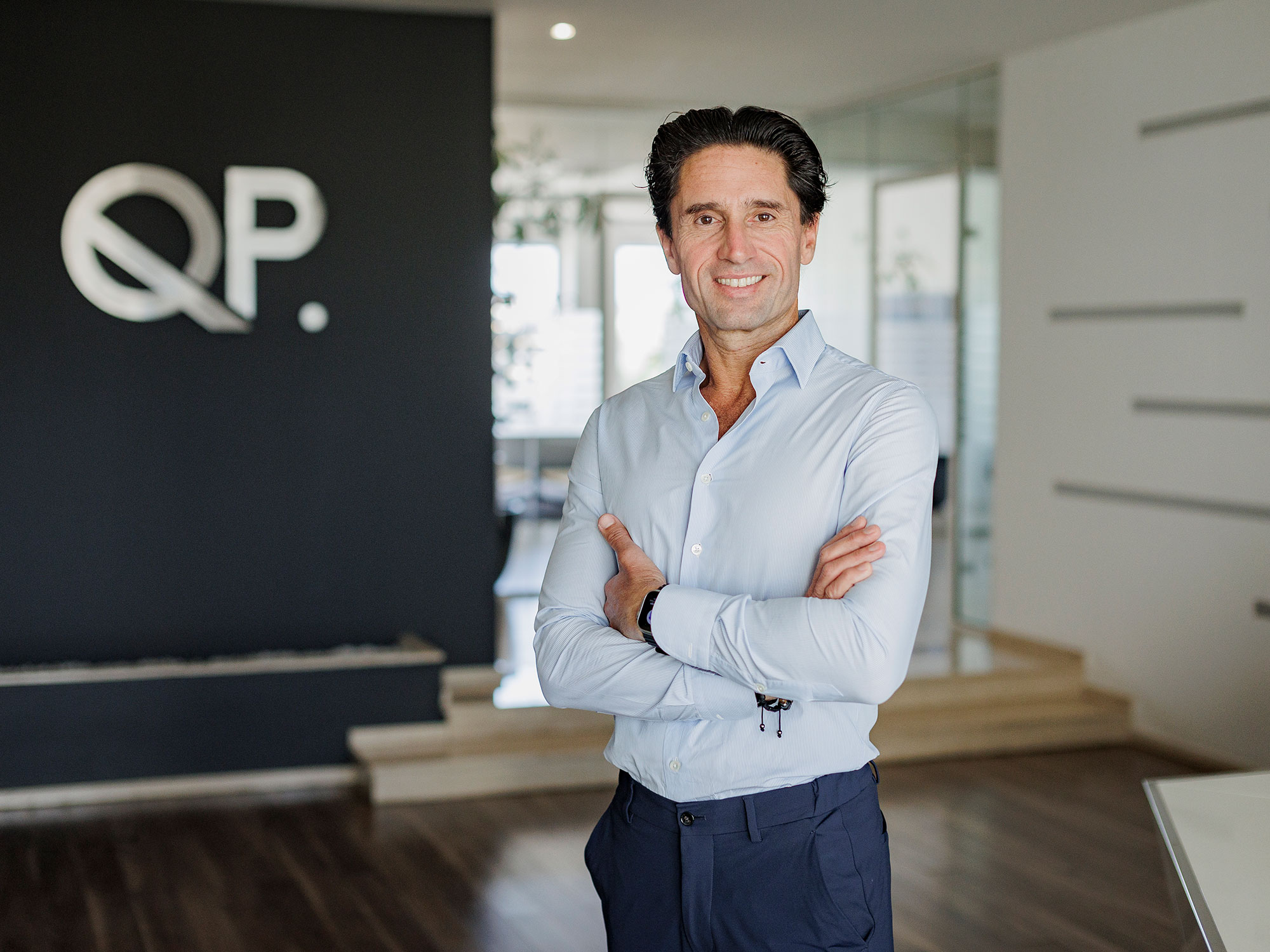
That experience also taught him how directly the challenges of a project affect the person or entity funding it. This understanding shaped QP’s approach, which begins with the numbers: sitting down with the client to make sense of the figures before developing a concept. From there emerged the firm’s defining idea: a single organisation able to provide a seamless service from start to finish.
“Instead of having ten consultants in a room, each protecting their own scope when things get challenging, QP offers a single point of responsibility and a coordinated effort,” Mr Xuereb says. “Ultimately, clients end up saving far more in time and cost, and that is something we take real pride in.”
Each of QP’s six disciplines is organised like a company in its own right, maintaining its specialist focus while benefiting from close collaboration with the others. Bringing them together is a simple principle that Mr Xuereb regularly reinforces with his team: “Take care of the client and the client will take care of you, and the business will keep on coming.”
As QP expanded both locally and overseas, the ambition grew beyond delivering successful projects to creating work with a lasting impact. That ambition took shape in DesignEQ, a dedicated masterplanning, architecture and interior design brand focused on luxury hospitality, guided by the belief that "emotion is our signature", and integrated directly with the wider QP offering. To build it, the firm sought out architects of exceptional calibre, many of whom had worked for some of the world’s biggest brands.
“We had the privilege of collaborating with some of the world’s most promising and talented architects, so we decided to bring them on board and invite them to join this ambitious and exciting journey,” Mr Xuereb says. “Each brought a distinctive perspective, helping shape DesignEQ into a brand with a truly international reach. Every place we design is about the feeling it creates and the memories people take away from it.”
Today, the group has studios and people on the ground in Malta, London, Dubai, Egypt and Libya, and its portfolio reflects that international reach. In Costa Rica, the team is master-planning a vast site that includes a luxury hotel, residences, a golf course and world-class facilities. In Dubai it has been commissioned to create a new masterplan for the entrance to Palm Jumeirah Two. Also in Dubai, QP and DesignEQ are working as interior designers and project and cost managers on a 103-storey tower set to become the city’s third tallest. “If you drive along the main thoroughfare opposite the Museum of the Future, you will shortly see a sign carrying the names DesignEQ and QP,” Mr Xuereb says with evident pride.
Expanding on multiple fronts has also brought its share of challenges, particularly when it comes to finding the right people. That is why QP created QP Academy, a programme aimed at identifying and rewarding students who show promise in their respective disciplines.
“We are lucky to have a number of senior professionals at QP who also lecture at the University of Malta, which gives us access to students as they complete their studies. Together with the University of Malta, we set up a scheme that rewards those who perform well and produce strong ideas, inviting many of them to take up internships with us over the summer, with a view to joining the firm in the longer term.”
Looking ahead, Mr Xuereb speaks about opportunities with enthusiasm. “Through 3D visuals, virtual reality and artificial intelligence, we can now walk clients through their buildings before we even lay the first stone, exploring an almost infinite range of design and sustainability options. We have long been at the forefront of materials selection, and our research into materials that perform far better than their predecessors allows us to design in new ways,” Mr Xuereb notes.
"Our headquarters in Malta is the backbone of the business, while our DesignEQ studios in London and Dubai are designed as an experience in themselves. We treat every client as our ultimate guest. Their journey begins the moment they arrive and carries through every stage of the design, down to a material library curated specifically for their project."
For Mr Xuereb, the future of QP comes down to remaining relevant and ahead of the curve, both in what the firm does and in how it does it. That, he believes, depends as much on attitude as on strategy. “If you don't enjoy what you’re doing, that’s a problem, and you have to ask whether it’s worth it. Of course there are challenges, but when you do what you love, it doesn’t feel like work, and that makes all the difference,” Mr Xuereb concludes.
Main Image:
